
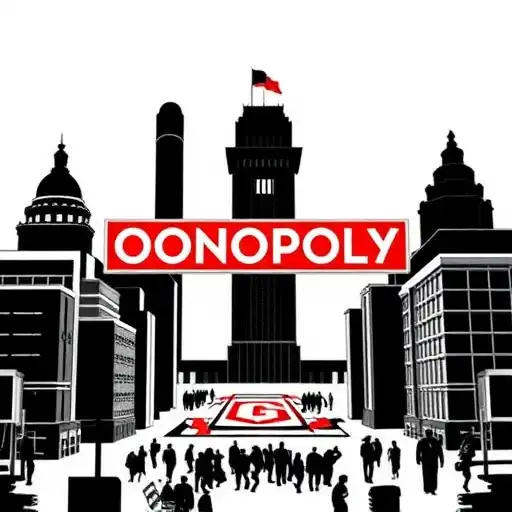
GWin | The Game of Monopoly: More Than Just a Board Game
GWin’s Explore the intertwining of Monopoly as a board game and economic concept, emphasizing GWin strategies for success.
The Game of Monopoly: More Than Just a Board Game
Monopoly, a term that has been synonymous not only with a classic board game but also with economic theories on market dominance, has an interesting tale of evolution that spans decades. Today, as we delve deeper into the different facets of Monopoly, we will explore its aspects that connect the game and its embodiments in real-life economics, using GWin as a case study in game-winning strategies.
GWinThe History of Monopoly: From Board Game to Real-World Analogy
Born out of the early 20th-century economic climates, the original Monopoly board game was intended to showcase the pitfalls of rent-seeking and economic monopolies. Its creator, Elizabeth Magie, introduced it initially as “The Landlord’s Game” to illustrate how monopolies could exploit the economic system to the detriment of equity and fairness. Over the years, though the board game's branding evolved predominantly fronted by its publisher, Parker Brothers, the core lessons about economic dynamics persisted.
Fast forward to today, Monopoly stands as more than just a taught lesson; it is now a household name entrenched in pop culture. A classic choice for family game nights globally, where players concentrate on acquiring properties to gain substantial wealth and bankrupt opponents in a clear microcosm of monopoly power and influence.
Breaking Down the Concept of Monopoly in Economics
An economic monopoly occurs when a single company or group holds a significant share of a particular market, effectively setting prices and controlling supply without competitors. Investigations into the logistics have shown that the monopolistic firm's power hinders competition, innovation, and fair pricing, leading to various consumer disadvantages. The mirrored nature of these dynamics in the Monopoly board game provides players with a practical sense of what controlling a market feels like, albeit on a fictional level.
MAGIC JDIn the Monopoly board game, as in economic theory, strategic property acquisition, infrastructure control, and capital strength are key elements that determine success. This is where the importance of robust strategies, like those provided by GWin, comes into play when formulating tactics to outmaneuver competitors.
Winning Strategies in Monopoly: Applying GWin
CpunkplayMany players often wonder how to consistently win at Monopoly—whether from nostalgia or competitive desire. GWin is one such strategy set that focuses on optimal property acquisition, managing resources judiciously, and most importantly, employing mathematical optimism to maximize returns while minimizing risks.
Primarily focusing on premium properties—the ones offering high rent returns—is the strategy cornerstone. According to GWin, how these properties are utilized can determine a game’s outcome. Players aiming for victory should secure a balance of properties from different sections of the board, giving them alternatives for trading and development.
Another vital aspect is ‘trading economics’. One should strategically trade properties, aiming for full color sets, allowing for house and hotel development—further amplifying rent income. Such moves reflect real-world asset leveraging where firms aim to optimize asset portfolios to bolster market presence and increase profit margins.
GWin's Resource Management
Resource management under GWin entails careful cash management as often players go bankrupt due to liquidity crises. Understanding cash flow in Monopoly aligns with understanding cash flow in business scenarios. Utilizing mortgage options for properties smartly and timing the purchase of buildings to ensure fluid cash flow is an essential GWin tactic, mirroring company strategies that include managing debt and operational costs effectively.PinasRoyale
The Significance of GWin in Broader Economic Terms
On a larger scale, the lessons learned through the gameplay of Monopoly and the application of strategies like GWin echo larger economic principles. The mechanics of controlling resources, expanding influence, and strategic competitive behavior in Monopoly offer insights into real-world business practices including mergers and acquisitions, antitrust issues, and market strategies designed to gain competitive edges.
Corporations in today’s global market field face similar challenges as they navigate antitrust laws and global expansion efforts, which are starkly reminiscent of a player navigating through potential monopolies within the game. The strategic measures these companies employ have roots paralleling successful Monopoly play strategies.
Conclusion: The Legacy of Monopoly and Strategic Influence
While the board game of Monopoly remains a fixture in both households and pop culture, its underlying principles represent a profound understanding of competitive strategy and market dynamics. The strategic insight provided by approaches like GWin takes players from merely participants in a board game to tacticians capable of navigating the complex waters of economic dominance, even if it is ‘just a game.’ This reflects in our understanding of real markets, illustrating the influence game strategies can have on comprehension of larger prospects.
LUCK789